
Overview
- If Normal Traps that become Equip Traps on activation were just proper Equip Trap Cards, then identifying them at a glance by subtype icon, searching for them in databases by subtype rather than rules text, and supporting them like Equip Spells, would all be so much easier.
- So many single-target Continuous Traps could easily have been released as Equip Traps instead of Continuous Traps (e.g. Spellbinding Circle, similar to Paralyzing Potion; or Call of the Haunted, which would basically be the Equip Trap equivalent to Premature Burial). Some of them might even cut down on rules text for self-destructing when the targeted monster leaves the field, given that that is just how Equip Cards inherently work.
This left me wondering why Konami never made Equip Traps a mechanically supported Trap Card subtype. So, I decided to mock several existing Traps up as Equip Traps.
Research
When looking into Equip Cards for this, I found that Konami had the perfect opportunity to make them an officially supported Trap Card subtype when revising Spell/Trap subtypes at the start of the second series of OCG sets. For this, let’s look at the manga debuts and appearances of a few cards that would have been relevant to the question of Equip Traps being a proper card type rather than an informal one:
- 17 June 1997: Dark Energy (Equip Spell) debuts in chapter 37, with no subtype indicated.
- 1 December 1997: Infinite Dismissal (Normal Trap), Insect Armor with Laser Cannon (Equip Spell) and Dragon Capture Jar (Continuous Trap) debut in chapter 60, with no subtypes indicated. (Dragon Capture Jar appears as a monster, not a Continuous Trap.)
- 30 March 1998: Spellbinding Circle (Continuous Trap with a single-target negative effect) debuts in chapter 75, with no subtype indicated.
- 27 July 1998: Kunai with Chain (Normal Trap that equips to a monster) debuts in chapter 91, with no subtype indicated.
- 25 January 1999: Mirror Wall (Continuous Trap) debuts in chapter 114, identified as a Permanent Trap. This is the earliest printed identification of a card’s subtype that I have found. Cyber Bondage, appearing in the same chapter, has no subtype identified.
- 1 February, 1999: Mirror Wall and Spellbinding Circle appear in chapter 115. Mirror Wall is identified as a Permanent Trap, while Spellbinding Circle has no subtype identified.
By 1 February 1999, only Mirror Wall had a printed indication of its subtype in the manga, despite not being the only Continuous Trap to have debuted by this point. After that, on 4 February, 1999, Konami released Vol. 1, the first set in the OCG, so let’s have a look at the release dates of several cards relevant to Equip Traps:
- 4 February 1999: Book of Secret Arts (Equip Spell) and Trap Hole (Normal Trap) are released in Vol. 1. Book of Secret Arts features no Equip Spell icon.
- 6 March 1999: Dragon Capture Jar (Continuous Trap) is released in Starter Box: Theatrical Release, featuring no Continuous Spell/Trap icon.
- 8 July 1999: Kunai with Chain (Normal Trap that equips to a monster) is released as a Yu-Gi-Oh! Duel Monsters II: Dark Duel Stories promotional card, with no subtype indicated.
- 20 August 1999: Revival of Dokurider (Ritual Spell) is released as a The Valuable Book 1 promotional card, featuring no Ritual Spell icon but seemingly indicating its subtype
- 27 January 2000: Paralyzing Potion (Equip Spell with a negative effect) debuts in Vol. 7, featuring no Equip Spell icon.
By January 2000, card subtypes had not been indicated on any cards via the icons that we’re familiar with today, and only Ritual Spells seem to have had a textual indication along those lines. On 18 April, 2000, the Yu-Gi-Oh! Duel Monsters anime began airing in Japan. 2 days later, Magic Ruler is released, beginning the second series of set releases in the OCG, and introducing subtype icons.
- 18 April 2000, anime: Negative Energy Generator (Equip Spell) debuts in episode 1, with no subtype indicated.
- 20 April 2000, OCG: Black Illusion Ritual (Ritual Spell) debuts as a The Valuable Book 2 promotional card, and Axe of Despair (Equip Spell), Snatch Steal (Equip Spell targeting an opponent’s monster), and Spellbinding Circle (Continuous Trap with a single-target negative effect) debut in Magic Ruler. Magic Ruler (and The Valuable Book 2 promotional cards) introduce subtype icons, with Black Illusion Ritual featuring a Ritual Spell Icon, Axe of Despair and Snatch Steal featuring Equip Spell icons, and Spellbinding Circle featuring a Continuous Spell/Trap icon.
- 25 April 2000, anime: Vortex (Normal Trap), Book of Secret Arts (Equip Spell), and Dragon Capture Jar (Continuous Trap) debut in episode 2, with no subtypes indicated.
- 5 May 2000, anime: Kunai with Chain (Normal Trap that equips to a monster) debuts in episode 3, with no subtype indicated.
- 20 June 2000, anime: Spellbinding Circle (Continuous Trap with a single-target negative effect) debuts in episode 10, identified as a Continuous Trap.
To reiterate, the anime did not immediately feature Spell/Trap subtype icons, even after the OCG introduced them. This suggests to me that they were devised by the OCG design team to replace any textual subtype indicators, namely Mirror Wall’s in the manga, and Ritual Spells’ in the OCG. Both Spells and Traps could be Continuous Spells or Traps, indicating that the design team weren’t averse to Spells and Traps sharing a subtype. Traps that equipped themselves to cards, or could have been imagined as Equip Traps, existed before and in the same set that debuted subtype icons, as did Equip Spells with negative effects or that targeted your opponent’s monsters. Konami had every opportunity to add Equip Traps as a Trap Card subtype to the game, but they didn’t. So I decided to mock some Equip Traps up myself.
The Mechanic

① Equip Trap Cards are Trap Cards that equip to a monster, like Equip Spells. ② As a Trap Card, Equip Traps must be Set on the field first. They cannot be activated during the turn they are Set, but starting from the next turn, they can be activated at Spell Speed 2 at any time. ③ Equip Traps apply an effect to 1 face-up monster on the field, called the equipped monster. ④ Equip Traps remain on the field once activated, occupying 1 of your Spell & Trap Zones. ⑤ If the equipped monster is flipped face-down or leaves the field, its Equip Cards are destroyed.
Equip Traps as a mechanic kind of design themselves, so I didn’t put too much thought into them here. They work the same as Equip Spells, just as Trap Cards instead of Spell Cards.
Sample Cards
Metalmorph
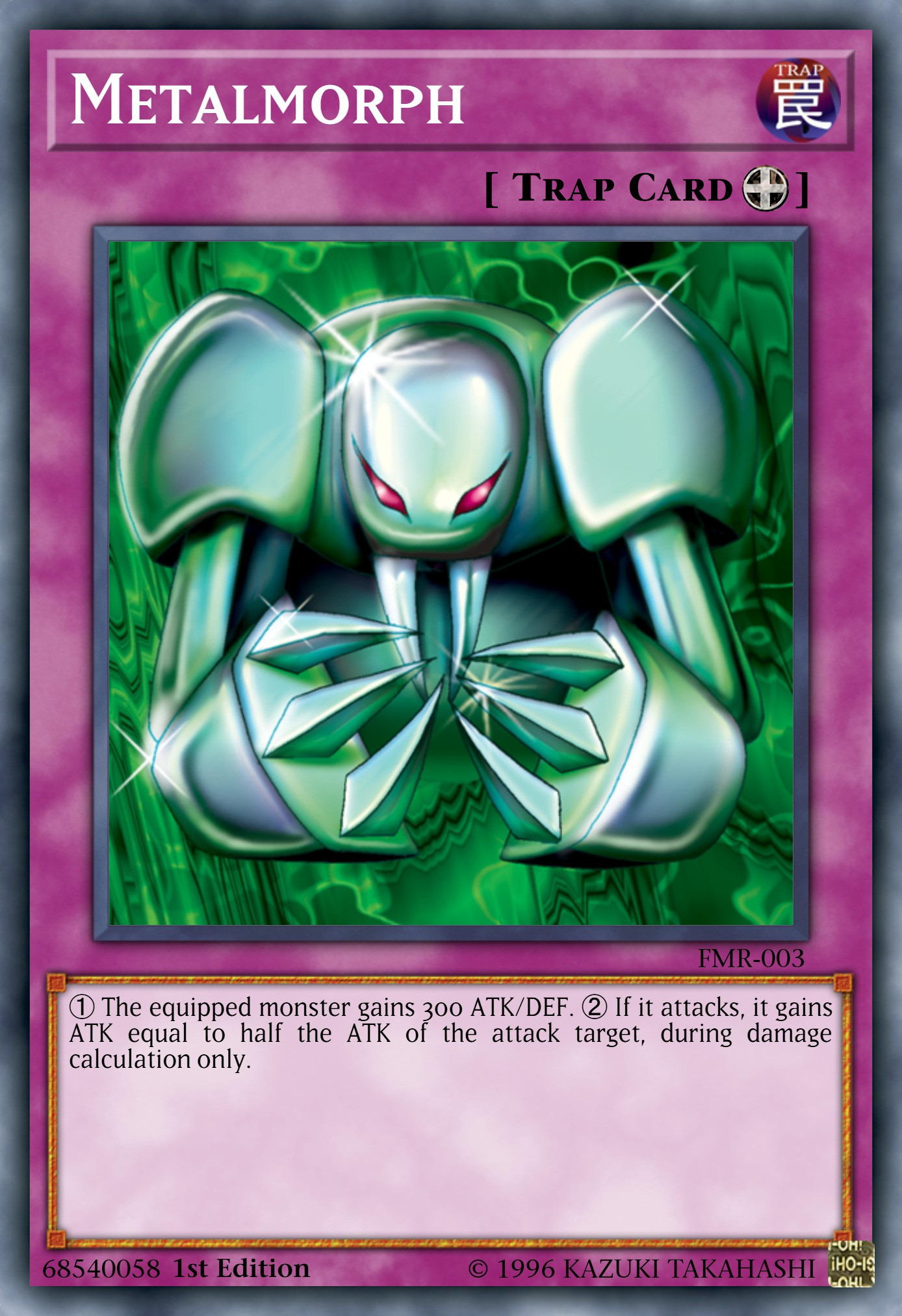
TCG Debut: Yu-Gi-Oh! Forbidden Memories Premium Edition promotional cards (2002)
Set ID: FMR-003
Card ID: 68540058
Card Type: Normal Trap >> Equip Trap
Development: Sep 2025
Original rules text: Target 1 face-up monster on the field; equip this card to that target. It gains 300 ATK/DEF. If it attacks, it gains ATK equal to half the ATK of the attack target, during damage calculation only.
Errataed rules text: ① The equipped monster gains 300 ATK/DEF. ② If it attacks, it gains ATK equal to half the ATK of the attack target, during damage calculation only.
Metalmorph is the card that prompted me to make proper Equip Traps. It is representative of Normal Traps that equip themselves to monsters upon activation. As an Equip Trap, it no longer needs to explicitly include the line that equips it to a monster, only the targeting constraints, if any, reducing the length of its rules text.
Spellbinding Circle
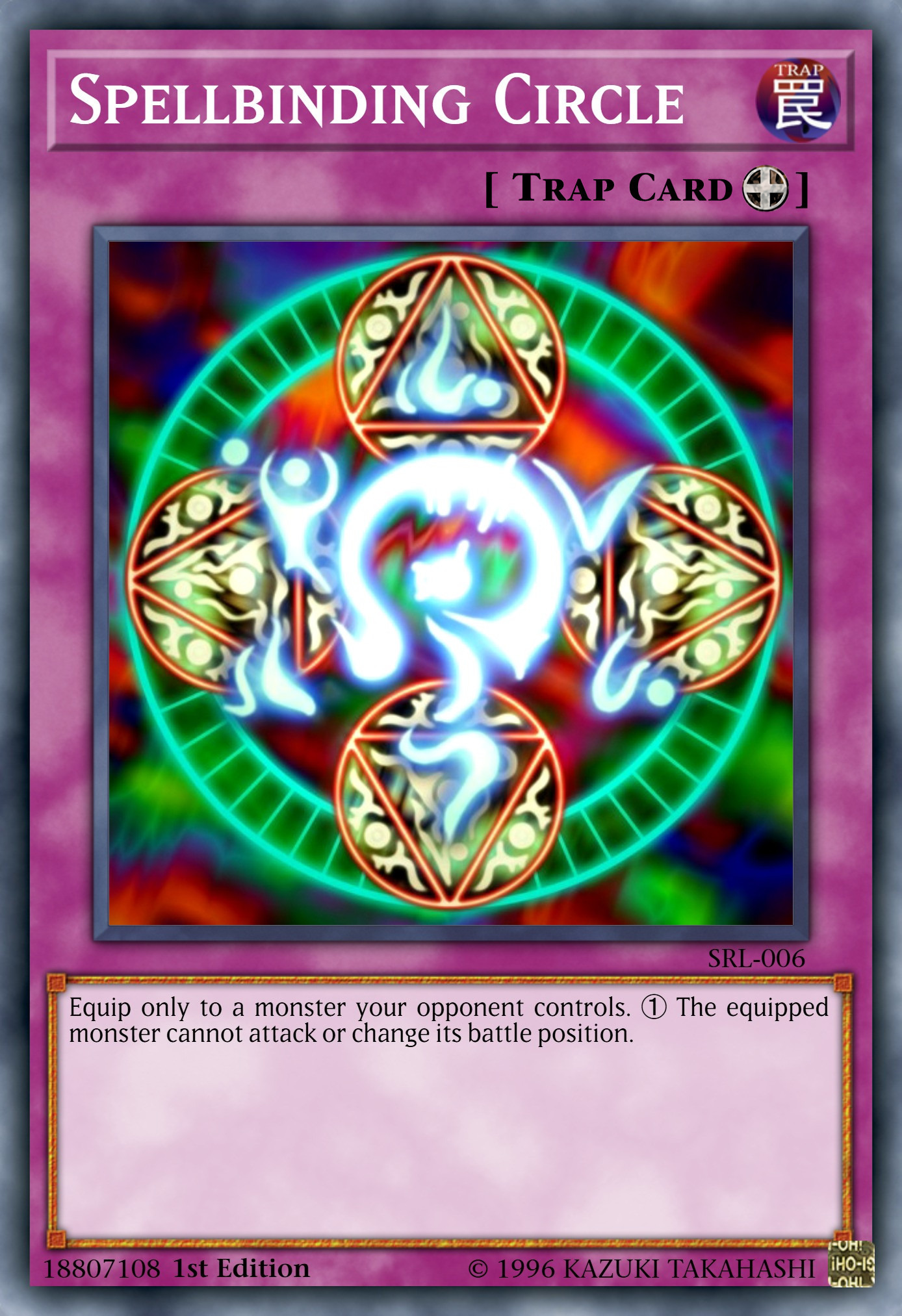
TCG Debut: Spell Ruler (2002)
Set ID: SRL-006
Card ID: 18807108
Card Type: Continuous Trap >> Equip Trap
Development: Sep 2025
Original rules text: Activate this card by targeting 1 monster your opponent controls; it cannot attack or change its battle position. When that monster is destroyed, destroy this card.
Errataed rules text: Equip only to a monster your opponent controls. ① The equipped monster cannot attack or change its battle position.
Spellbinding Circle is representative of Continuous Traps that apply an effect to a single target and could easily have been made as Equip Traps. As an Equip Trap, it no longer needs to include the line about self-destructing when the target is destroyed, as that is how Equip Cards inherently work. Letting the rules handle it in this specific case also makes the card better, as it self-destructs if the target leaves the field at all, rather than just when it is destroyed. Being an Equip Trap would also make it slightly worse, in that it could not target face-down monsters like the original would be able to, but that is a relatively niche use case. The rest remains pretty much the same, with the targeting requirements becoming the equip targeting constraints.
Call of the Haunted

TCG Debut: Pharaoh’s Servant (2002)
Set ID: PSV-012
Card ID: 97077563
Card Type: Continuous Trap >> Equip Trap
Development: Sep 2025
Original rules text: Activate this card by targeting 1 monster in your GY; Special Summon that target in Attack Position. When this card leaves the field, destroy that monster. When that monster is destroyed, destroy this card.
Errataed rules text: ① Activate this card by targeting 1 monster in your GY; Special Summon it in Attack Position and equip it with this card. When this card leaves the field, destroy that monster.
Call of the Haunted is also representative of Continuous Traps that apply an effect to a single target and could easily have been made as Equip Traps. In fact, making it an Equip Trap would make it basically a Trap Card version of Premature Burial. Like Spellbinding Circle, the rules would handle its self-destruction when its target leaves the field, and would strengthen it by ensuring it is destroyed whenever it leaves the field at all, not just when it is destroyed. The rest remains pretty much the same, with the targeting requirements becoming the equip targeting constraints, following Premature Burial’s templating.
Kunai with Chain

TCG Debut: The Duelist Genesis (2008)
Set ID: TDGS-EN098
Card ID: 37390589
Card Type: Normal Trap
Development: Sep 2025
Original rules text: Activate 1 or both of these effects (simultaneously);
● When an opponent’s monster declares an attack: Target the attacking monster; change that target to Defense Position.
● Target 1 face-up monster you control; equip this card to that target. It gains 500 ATK.
Errataed rules text: ① Activate 1 or both of these effects (simultaneously);
● When an opponent’s monster declares an attack: Target the attacking monster; change that target to Defense Position.
● Target 1 face-up monster you control; equip this card to that target as an Equip Trap that gives it 500 ATK.
Kunai with Chain is the problem child when it comes to adapting Normal Traps that equip themselves to monsters into Equip Traps. It is a Trap with a modal effect, which can be activated to change an attacking monster to Defense Position and/or equip to a monster to give it 500 ATK. In other words, it can be activated without equipping it to a monster. After discussions on Reddit regarding its modal effect, I did some more research into Equip Spells. What I found was that, according to the Yugipedia page on Equip Spells, Equip Spells must (and do) either implicitly target a monster to equip to right from activation, or Special Summon a monster and immediately equip to it during resolution. I ran some searches in Duelingbook to double check this, and the only card I could find that seemed like it might be an exception, that might do multiple things as part of its effect, with equipping to a monster being optional, was Golden Rule:
Golden Rule
Equip Spell
(This card is always treated as a “Crystal” card.)
Place 2 “Crystal Beast” monsters from your Deck face-up in your Spell & Trap Zone as Continuous Spells, then Special Summon 1 “Crystal Beast” monster from your hand or GY with a different name than those cards, and if you do, equip it with this card. When this card leaves the field, destroy that monster. You can only activate 1 “Golden Rule” per turn.
Given that the PSCT conjuctive separating the Special Summon and equip part of the effect from the rest is “then”, which indicates “A is required but not B, sequential”, I assumed it might be able to be activated even if you didn’t have a Crystal Beast available to Special Summon. I asked about this on Reddit in r/yugioh’s rulings megathread, and the answer I was given was that no, it cannot be activated unless you can fulfil all parts of the effect. It would only be optional, and therefore activatable if you had no Crystal Beasts available to Special Summon, if it said “Do A, then you can equip to X.”
In other words, a modal activation effect like Kunai with Chain’s couldn’t be printed on an Equip Trap without making the equip part of the effect mandatory, thereby eliminating the point of it being a modal card. With that said, making it become an Equip Trap at resolution would still be on the table, hence the rules text that I settled on that explicitly makes it an Equip Trap, but otherwise is exactly the same as its TCG rules text.
Other Potential Equip Traps
While doing my research, I did have a look at which Normal and Continuous Traps would be able to be errataed as Equip Traps with minimal issues. The following categories of Trap Cards should be easy to convert:
- Normal Traps that must equip to a monster as part of their activation effect, i.e. just about every Normal Trap that becomes an Equip Card, except Kunai with Chain.
- Continuous Traps that target only 1 monster, apply an effect to it, and self-destruct when that monster is destroyed or leaves the field.
At time of writing, Continuous Traps that match this description all have effects that either:
- Buff their targets:
- Battle-Scarred
- Battleguard Rage
- Dimension Guardian
- Dimension Sphinx
- Dragon’s Bind
- Follow Wing
- Moon Dance Ritual
- Phantom Knights’ Sword
- Rare Metalmorph
- Safe Zone
- Debuff their targets:
- Dimension Mirage
- Fiendish Chain
- Miniaturize
- Nightmare Wheel
- Phantom Knights’ Fog Blade
- Shadow Spell
- Shattered Axe
- Spellbinding Circle
- Vain Betrayer
- Special Summon a monster from the Deck:
- Abyss-sphere
- Special Summon a monster from the GY:
- Amazoness Willpower
- Birthright
- Call of the Haunted
- Core Reinforcement
- Fossil Excavation
- Glorious Illusion
- Graceful Revival
- Limit Reverse
- Monster Rebone
- Oasis of Dragon Souls
- Powerful Rebirth
- Psychic Tuning
- Soul Resurrection
- Wicked Rebirth
- Special Summon a monster from banishment:
- Brain Hazard
- Escape from the Dark Dimension
- Miraculous Descent
- Release from Stone
- Take control of an opponent’s monster:
- Brainwashing Beam
- Crackdown
- Evil Eye Mesmerism
- Tuner’s Scheme
Gallery


